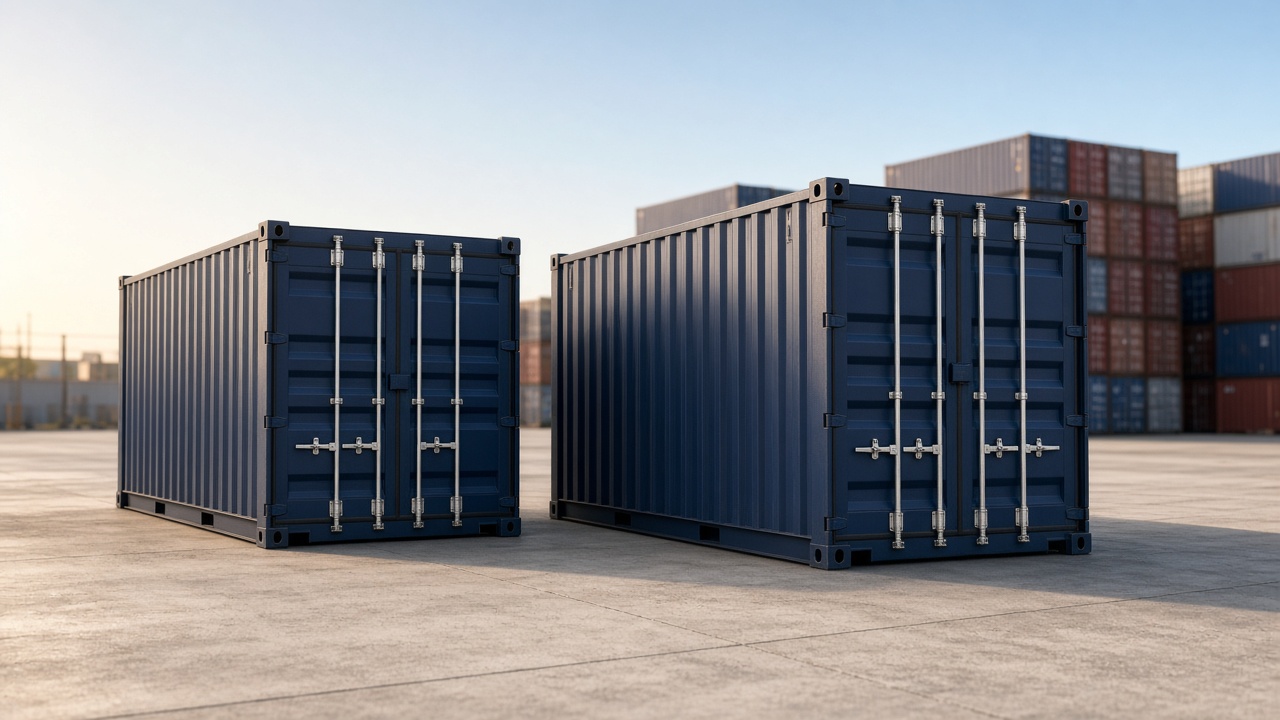


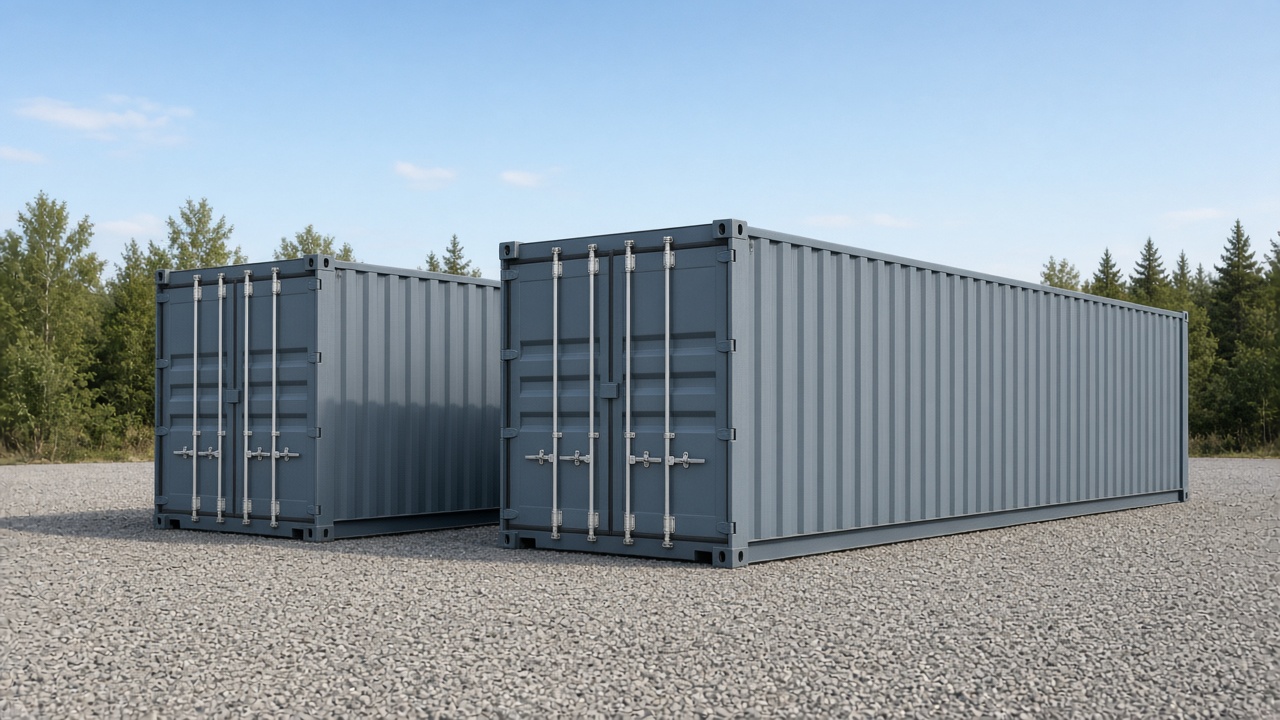
Choosing between a 20ft and a 40ft shipping container is the first decision most buyers make, and it is easy to get wrong. A 40ft gives you twice the floor space, but it also needs a much longer, clearer delivery path. A 20ft fits almost anywhere, but it fills up faster than people expect.
This guide compares the two sizes (plus the 40ft High Cube) on the things that actually decide the purchase: usable space, weight, delivery access and what you plan to do with the container.
Quick answer
- Pick a 20ft if your lot or access road is tight, you need storage for a garage's worth of equipment or inventory, or you want one unit that is easy to move later.
- Pick a 40ft if you need more than about 150 sq ft of floor space, you are storing long items (pipe, lumber, vehicles), and a long truck can reach your site.
- Pick a 40ft High Cube if you are building an office, workshop or home, or you need tall shelving. It has the same footprint as a standard 40ft with about one extra foot of height.
Size comparison at a glance
Figures below are typical for standard dry containers. Exact numbers vary slightly by manufacturer, so confirm them on the unit you are quoted.
| 20ft standard | 40ft standard | 40ft High Cube | |
|---|---|---|---|
| External length | 20 ft (6.06 m) | 40 ft (12.19 m) | 40 ft (12.19 m) |
| External height | 8 ft 6 in (2.59 m) | 8 ft 6 in (2.59 m) | 9 ft 6 in (2.90 m) |
| Internal length | about 19 ft 4 in (5.9 m) | about 39 ft 6 in (12.0 m) | about 39 ft 6 in (12.0 m) |
| Internal floor area | about 150 sq ft (13.9 m²) | about 305 sq ft (28.3 m²) | about 305 sq ft (28.3 m²) |
| Internal volume | about 1,170 cu ft (33 m³) | about 2,390 cu ft (67 m³) | about 2,690 cu ft (76 m³) |
| Empty weight (tare) | about 4,900 lb (2.2 t) | about 8,200 lb (3.7 t) | about 8,600 lb (3.9 t) |
| Standard pallets (48 × 40 in) | about 10 | about 20 | about 20 |
Two things stand out. First, a 40ft is not "a bit bigger": it is double the floor area and volume. Second, the High Cube adds height, not floor space, so it only helps if you will stack or stand inside.
Space: how much do you really need?
People tend to underestimate. A good rule is to measure what you want to store, add 20 to 30 percent for walking room and shelving, and then compare against the floor area above.
- One-car garage contents, seasonal stock, tools for a small crew: a 20ft is usually enough.
- A full house move, a contractor's materials and equipment, retail overflow stock: a 40ft is usually the safer choice.
- Long items: anything over about 19 ft (lumber, pipe, a boat on a trailer) only fits in a 40ft.
If you are unsure, two 20ft units are an option too. They cost more per square foot than one 40ft, but they can be placed in separate spots and moved independently.
Delivery: the factor buyers forget
Most containers arrive on a tilt-bed truck or a trailer that slides the container off at the back. That needs straight, open space in front of the final position, plus room overhead for the bed to tilt.
- 20ft: plan for roughly 100 ft of straight clearance in line with the drop spot.
- 40ft: plan for roughly 150 to 180 ft.
- Both: about 12 ft of width, around 15 to 18 ft of overhead clearance (watch for power lines and branches), and firm, level ground.
These are rules of thumb. Your supplier or hauler will confirm what their truck needs, so send them photos of the access and the drop spot when you ask for a quote. If a long truck cannot turn into your lot, the 20ft decision is made for you.
Weight and foundation
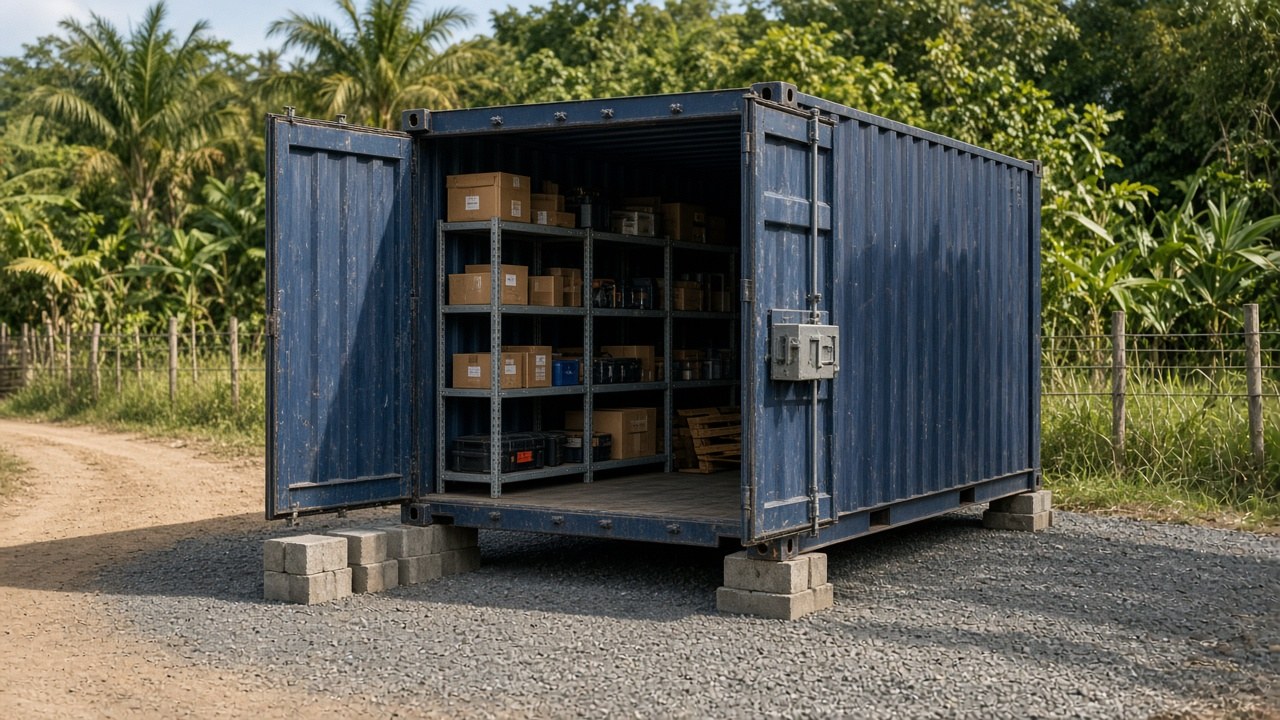
An empty 20ft weighs a little over two tons and a 40ft close to four. On soft ground they will sink unevenly, which makes doors hard to open over time. Most buyers set the corners on concrete blocks, railroad ties or a gravel pad. A 40ft needs support at the four corners at minimum, and many people add supports at the midpoint for long-term use.
Best size by use case
Storage on a farm, yard or business lot. 20ft for tools and moderate inventory; 40ft if you are clearing out a warehouse, storing equipment or keeping several months of stock.
Construction site storage. The 20ft is the common choice because it fits on tight urban sites and moves easily between projects. Large or long-running sites often use a 40ft.
Site office, workshop or pop-up shop. A 40ft High Cube gives you room for insulation, lighting and a ceiling without feeling cramped. A 20ft works for a compact office for one or two people.
Container home or cabin. Almost always a 40ft High Cube, alone or combined with other units. The extra height matters once you add insulation and flooring.
Shipping your own goods. A 20ft suits heavy, dense cargo such as machinery or stone, because it reaches its weight limit before it runs out of space. A 40ft suits lighter, bulky cargo such as furniture.
New vs used: does it change the size choice?
No, but it changes what you get. Condition grades usually fall into a few groups:
- New (one-trip): used for a single export voyage, near-new condition, best for homes, offices and anything visible.
- Cargo-worthy: used, structurally sound and certified fit for shipping again.
- Wind and watertight (WWT): used, no holes, doors seal, but no shipping certification. A common choice for storage.
- As-is: cheapest grade, may need repairs, only for buyers who can inspect it first.
Availability of each grade depends on the size and the city. In many markets used 40ft units are easier to find than used 20ft ones, so being flexible on size can widen your options.
Questions to answer before you request a quote
- What will you store or build, and roughly how much floor space does it need?
- Do you need standard height or High Cube?
- New (one-trip) or used, and which grade?
- Delivery address, and how much straight clearance is there at the drop spot?
- When do you need it?
- One unit or several?
Having these ready means a supplier can come back with a real quote for your size, condition and delivery address, instead of a generic list.
FAQ
How much bigger is a 40ft container than a 20ft? About twice as big. The floor area goes from roughly 150 sq ft to roughly 305 sq ft, and the volume from about 1,170 to about 2,390 cubic feet.
Is a 40ft container twice the price of a 20ft? Not necessarily. It depends on the condition, the city, availability at that moment and the delivery distance. That is why we don't publish fixed prices: the fair comparison is quotes for the same size and grade, delivered to your address.
What is a High Cube container? A container that is 9 ft 6 in tall instead of 8 ft 6 in, which gives about one extra foot of interior height. It is most common in 40ft. It is the usual choice for offices, workshops and homes.
Will a 40ft container fit on my property? Measure the drop spot (40 ft plus some working room) and the straight approach in front of it (roughly 150 to 180 ft for a tilt-bed truck). If either is short, a 20ft is the safer option.
Can I get quotes for both sizes at once? Yes. Mention both in your request and you can compare a 20ft and a 40ft delivered to the same address.
Get options for your size
ContainerHub treats your order as a search. You tell us the size (20ft, 40ft or 40ft High Cube), new or used, your delivery city and when you need it. We look for options from independent suppliers and send you a quote, usually within 24 to 48 hours. Asking for options does not commit you to buy and involves no payment.
- Request a container quote
- Buy containers in the United States
- Buy containers in Mexico
- Buy containers in Costa Rica
Still deciding between 20ft and 40ft? Send us your request with what you plan to store, your city and a photo of the delivery access, and we'll come back with 20ft and 40ft options in 24 to 48 hours.