


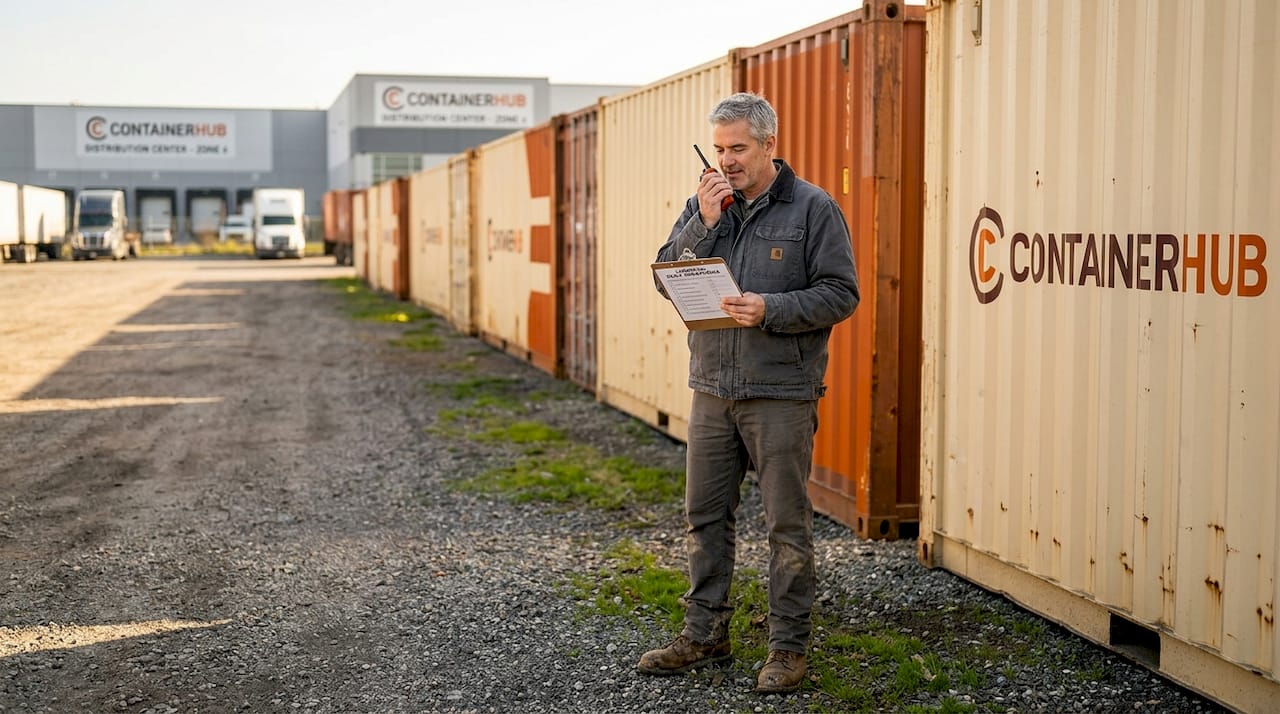
Common Empty Container Management Challenges in Depots
Empty container management, the operational practice known in the industry as empty repositioning and inventory control, is one of the most underestimated cost drivers in depot operations. As global trade volumes grow and supply chains fragment across more routes and geographies, common empty container management challenges have multiplied in both frequency and complexity. Depot managers who once tracked a handful of container types across stable lanes now contend with volatile return policies, severe yard congestion, and repositioning costs that erode margins before a single full container moves. This article breaks down the core challenges so you can address them with clarity and intention.
Table of Contents
- Key Takeaways
- 1. Yard congestion from capacity constraints
- 2. Trade imbalances creating repositioning surges
- 3. Policy disruptions changing where empties can go
- 4. Empty legs reducing fleet productivity
- 5. Commercial disputes and fee structures disrupting depot flow
- 6. Poor inventory visibility hiding localized shortages
- My take on what actually matters here
- How Containerhub helps depots take back control
- FAQ
Key Takeaways
| Point | Details |
|---|---|
| Trade imbalances drive volume spikes | Over 4.5 million TEU in empties need repositioning monthly, overwhelming depot planning. |
| Yard congestion is a policy problem | Gate appointment failures and driver shortages cause congestion as much as physical space limits. |
| Policy disruptions require flexible workflows | Sudden return location changes force depots to adapt within tight windows or face heavy financial penalties. |
| Localized shortages are invisible on paper | Total inventory counts mask empty container logistics challenges at specific locations where demand is highest. |
| Technology accelerates every fix | Real-time tracking and digital gate management reduce dwell times, appointment backlogs, and repositioning costs. |
1. Yard congestion from capacity constraints
Yard congestion is the most visible symptom of deeper container management issues, yet most operations treat it as a space problem when it is really a coordination problem. When truck availability drops or gate appointment windows tighten, containers sit longer than planned. Dwell times extend. The yard fills. Throughput collapses.
The JNPA container crisis in India illustrates how fast this can spiral. When a shortage of drivers left more than 2,500 containers stranded in the yard, port authorities had to activate emergency green channel gate entries and push trailers to run three to four trips daily instead of the standard two. Rail evacuation was also deployed to relieve pressure.
The lesson here is not that more trucks fix congestion. It is that yard congestion often reflects appointment and gate policy failures more than purely physical space limits. Targeted adjustments to those policies produced measurable throughput gains at JNPA within days.
- Review gate appointment windows quarterly and adjust slot availability to match peak driver availability patterns
- Build a direct delivery option for high-volume customers to bypass yard storage
- Track dwell time by container type weekly to catch accumulation before it becomes congestion
Pro Tip: Pair gate software with real-time slot monitoring. When a slot goes unfilled 30 minutes before its window, auto-release it to a standby queue. This alone can recover 10 to 15 percent of gate capacity during peak periods.
2. Trade imbalances creating repositioning surges
The structural driver behind most empty container logistics challenges is trade imbalance. When more goods flow from one region than return, empties accumulate at the destination and must be shipped back empty at significant cost.
The scale of this problem has grown substantially. Empty containers needing repositioning increased by 50 percent over seven years, now reaching 4.5 million TEU per month. For every 10 full containers arriving, more than 4 empties require repatriation. That ratio directly determines your depot’s intake pressure, handling workload, and storage planning requirements.
Here is where most depot planning models fall short. They calculate total container volume but do not weight it by lane imbalance ratios. A depot serving an export-heavy region may look well-utilized on paper while actually absorbing far more inbound empties than its yard layout was designed for.
- Source lane imbalance data from your shipping line partners quarterly
- Calculate a per-lane empty return ratio and map it against your yard zone capacities
- Adjust inbound appointment windows based on projected empty surges, not just average volumes
- Negotiate pre-positioning agreements with nearby depots to share overflow during peak imbalance periods
Planning depot capacity must factor in lane imbalance indicators, not just aggregate throughput numbers. This shift in planning methodology alone can reduce unexpected yard saturation events significantly.
3. Policy disruptions changing where empties can go
If trade imbalance is the slow-burn challenge, sudden policy disruptions are the acute crisis. Geopolitical events, port authority decisions, or carrier-specific operational changes can overnight redirect where empties are accepted, under what conditions, and at what cost.
The Maersk Hormuz Strait situation in early 2026 is a textbook case. Due to operational disruptions, empties were no longer accepted at standard locations. Authorized drop-off depots were shifted to Salalah, Sohar, and Jeddah, with specific drop-off charges applied at each location. Depots that had standing return workflows in place for affected ports had to rebuild their exception processes in real time.
“Return-location restrictions override local availability; authorized depots must be enforced strictly to avoid penalties and operational disruptions requiring flexible exception workflows within strict time windows.” Maersk, 2026
The drop-off charges attached to these kinds of policy changes are not trivial. Abu Dhabi charged $600 per TEU, while Bahrain reached $3,000 per container and Kuwait hit $2,500. A depot moving 200 containers per week through an affected lane does not absorb that cost quietly.
- Build a policy alert integration that flags carrier notices directly into your depot operations software
- Maintain a pre-approved list of alternative drop-off depots for each major shipping line partner
- Define authorization workflows that allow operations staff to reroute containers without waiting for management escalation
4. Empty legs reducing fleet productivity
Every time a truck moves an empty container without earning revenue, it is consuming fuel, driver time, toll fees, and handling capacity. That is the core of what the industry calls “empty legs,” and it represents one of the most persistent challenges in container tracking and fleet productivity.
Empty repositioning reduces effective fleet size and drives margin erosion through unproductive movements. The planning complexity compounds the financial hit. Dispatchers are constantly chasing container locations, managing extra turns, and rescheduling pickups when container availability shifts.
- Build a trip-pairing discipline into dispatch planning. Before routing a truck to collect an empty, identify whether a nearby full load can follow the empty return
- Create a reuse window. Flag containers returning to a depot for potential immediate reassignment before they are formally inducted into yard storage
- Track empty-to-loaded ratio per driver and per lane weekly to identify where empty legs concentrate most heavily
- Coordinate with shipping lines to identify pre-positioning opportunities that allow empties to move toward future demand rather than back to default depots
The real issue, as the empty leg problem demonstrates, is not having enough containers in total. It is getting the right empty to the right place at the right time. That requires dynamic scheduling tools, not just aggregate inventory counts.
Pro Tip: When building your week’s dispatch schedule, reserve 15 to 20 percent of driver capacity specifically for confirmed empty reuse moves. This creates a structured buffer that reduces the reactive scramble that turns one empty move into three.
5. Commercial disputes and fee structures disrupting depot flow
Fee disputes between depot operators, truckers, and terminal authorities can shut down operations as fast as any physical bottleneck. This is an underreported dimension of overcoming container management problems, and it often blindsides operations managers who focus primarily on physical throughput.
At JNPA, transporters announced a voluntary service suspension effective May 28, 2026, citing unacceptably heavy LOLO (lift-on/lift-off) charges at the Empty Container Yard. When transporters refuse to operate, containers stop moving. Dwell times spike. Demurrage risk climbs across every container in the affected zone.
The financial mechanics here matter. When fee structures make it economically irrational for transporters to operate, the depot loses control of its own throughput regardless of how well the yard is organized or how modern the gate system is.
- Maintain a fee sensitivity threshold for each transporter partner. When charges approach that threshold, trigger a renegotiation conversation proactively rather than waiting for a stoppage
- Build contingency routing plans that identify alternative carriers or rail options for each major corridor
- Document all fee disputes with timestamps and container references to strengthen your position in negotiations and avoid demurrage liability
Managing these commercial relationships as actively as physical yard operations is not optional. Fee disputes that linger become operational crises.
6. Poor inventory visibility hiding localized shortages
This challenge is more subtle than congestion or fee disputes, but it may be the most operationally costly. Depot managers who rely on aggregate inventory counts consistently underestimate how to manage empty containers effectively at the location level.
Total stock numbers can look healthy while specific container types or sizes face critical shortages at the depots where demand is actually concentrated. Inventory metrics should shift from aggregate stock counts to dynamic, location-based availability and container cycling speed to avoid these hidden shortages.
The gap between what your system says you have and what is actually accessible, in the right size, in the right condition, at the right depot, is where optimizing empty container usage gets compromised. A depot reporting 500 units on hand may have 400 of them in a single size type that no one currently needs, while a 40-foot high-cube shortage stalls three bookings that afternoon.
Managing empties successfully requires real-time visibility, dynamic planning, and the capacity to respond quickly when distributions shift. Spreadsheets and end-of-day reports cannot deliver that. Only live, location-tagged inventory data can.
My take on what actually matters here
I’ve spent enough time in depot operations and talking with logistics managers to see a consistent pattern: the problems that cost the most are rarely the ones that get the most attention.
Every manager I’ve met tracks total container count. Almost none of them track container cycling speed by location. That gap is where empty container logistics challenges quietly drain profit. When I look at depots that handle volume spikes without losing control, they share one trait: they treat their inventory as a flow problem, not a storage problem. They ask how fast containers are moving through, not how many they have.
The disruptions I’ve seen expose something important: rigid systems built for stable conditions fracture when conditions change. The Hormuz Strait policy change, the JNPA fee dispute, the 50-percent surge in repositioning volumes, these are not outliers. They are the operating environment now. The depots that recover fastest are the ones that had exception workflows built before the exception happened.
My honest take: technology is not a nice-to-have for solutions for empty container management. It is the infrastructure that makes all the other fixes possible. Digital gate management, real-time yard visibility, integrated billing, and carrier policy alerts are not features. They are the minimum viable operating layer for a modern depot. If you’re still running on spreadsheets and phone calls when a disruption hits, you are already behind. And in this environment, being behind costs money you cannot recover.
— William Carley
How Containerhub helps depots take back control
Managing empty container inventory effectively requires more than operational discipline. It requires technology that surfaces the right information at the right moment and removes the manual steps that slow everything down.
Containerhub is built specifically for empty container depot operations. The platform digitizes gate-in and gate-out workflows, delivers real-time yard visibility, and connects depot teams with shipping line systems via EDI integration. When a return policy changes overnight, your team sees it and can act on it without rebuilding workflows from scratch.
Containerhub’s depot management software also addresses appointment scheduling, damage inspections, and billing in one connected system. Less manual reconciliation. Fewer errors. Faster container turns. If you are ready to replace reactive firefighting with operational control, explore what ContainerHub can do for your depot.
FAQ
What are the most common empty container management challenges?
The most common challenges include yard congestion from driver and capacity shortages, trade imbalance-driven repositioning surges, sudden policy changes altering return locations, empty leg inefficiency, commercial fee disputes, and poor real-time inventory visibility at the location level.
How do trade imbalances affect empty container depot operations?
Trade imbalances drive disproportionate empty container inflows at destination depots, with over 4.5 million TEU requiring repositioning monthly. Depots must plan yard capacity around lane imbalance ratios, not just total throughput.
Why do localized container shortages happen even with adequate total inventory?
Total inventory counts do not reflect which container sizes are available at which depots. Localized shortages emerge when the right equipment type is concentrated at the wrong location, making dynamic, location-based tracking the only reliable solution.
How can depot managers reduce the impact of policy disruptions?
Build pre-approved alternative return location lists for each shipping line partner, integrate policy alert systems into your depot software, and create exception authorization workflows that allow operations staff to reroute containers without management escalation delays.
What technology features matter most for managing empty container depots?
Real-time yard visibility, digital gate management, EDI integration with carrier systems, and location-tagged inventory tracking are the highest-impact capabilities. These allow depots to respond to disruptions, reduce dwell times, and eliminate the manual steps that slow container turnaround.