

Container Fleet Visibility Across Depots in 2026
Managing containers across multiple depots without real-time data is like running a warehouse with the lights off. Container fleet visibility across depots remains one of the most expensive blind spots in logistics today, with fragmented data, siloed portals, and manual tracking creating delays that compound across every handoff. If you’re responsible for fleet performance across two or more depot locations, you already know the cost. This article breaks down how modern tracking technologies, integrated software, and smarter workflows close those gaps and what it actually takes to get there.
Table of Contents
- Key takeaways
- Container fleet visibility across depots: the fundamentals
- Technologies enabling real-time container tracking
- Operational benefits of improved fleet visibility
- Challenges in achieving effective visibility across depots
- Implementing a visibility strategy for multi-depot operations
- My take on where visibility is actually heading
- How Containerhub improves visibility across your depot network
- FAQ
Key takeaways
| Point | Details |
|---|---|
| Visibility gaps are costly | Poor container fleet visibility across depots drives unplanned downtime, detention charges, and scheduling failures. |
| Layered tracking beats single tools | Combining GPS, RFID, and IoT sensors with centralized software gives more reliable data than any one technology alone. |
| Exception management is the real win | Real-time data only delivers value when paired with automated alerts and fast exception handling workflows. |
| Integration over replacement | Connecting tracking data via APIs into a central TMS or BI tool outperforms replacing every system with one platform. |
| Phased rollout reduces risk | Piloting visibility solutions at one depot before scaling prevents costly misalignment and data quality failures. |
Container fleet visibility across depots: the fundamentals
Before you can fix a visibility problem, you need to be precise about what you’re actually managing. A container fleet spans the physical boxes themselves, the vehicles moving them, and the depot locations where they’re stored, inspected, repaired, and released. Each depot operates with its own gate processes, yard layouts, and data systems. That fragmentation is exactly where visibility breaks down.
The distinction between a depot and a terminal matters here. Terminals are typically port-connected, high-volume throughput facilities with established tracking infrastructure. Depots, especially empty container depots, are often more distributed, lower in automation investment, and heavily dependent on paper-based or spreadsheet-driven processes. When you’re managing a fleet across five depots in different cities, the operational picture you see is only as good as the weakest data source in that network.
| Characteristic | Container depot | Port terminal |
|---|---|---|
| Primary function | Storage, repair, inspection of empties | Cargo loading, discharge, transshipment |
| Automation level | Low to medium | Medium to high |
| Tracking infrastructure | Often manual or basic | EDI, AIS, gate cameras standard |
| Visibility challenges | Fragmented, paper-based records | Data overload, system integration |
| Inter-depot coordination | Rarely standardized | Managed by shipping line systems |
The operational impact of poor visibility shows up in three specific ways. First, scheduling suffers because you can’t confirm container availability across locations without making phone calls. Second, maintenance gets missed because there’s no centralized record of inspection history by unit. Third, asset utilization drops because containers sit idle at one depot while another location runs short. Each of these problems has a direct cost attached to it, and none of them require exotic technology to fix. They require integrated data.
Key visibility gaps that logistics managers consistently report include:
- No single view of container status across all depot locations
- Delayed or missing gate-in and gate-out records from remote sites
- Inconsistent damage inspection data that doesn’t sync with repair workflows
- No automated alerts when containers exceed dwell time thresholds
- Inability to confirm container availability without direct phone contact with depot staff
Technologies enabling real-time container tracking
The technology stack for container fleet visibility has matured significantly. You no longer need to choose between precision and affordability. What you do need is a clear understanding of which tools solve which problems, and why layering them matters more than picking one.
GPS tracking provides coarse-level location data for vehicles and containers in transit. It’s the baseline. RFID tags add door-level precision at gate entry and exit points, confirming which specific unit moved and when. IoT sensors go further, capturing temperature, humidity, shock events, and door open/close status for cargo integrity monitoring. GPS combined with RFID and camera verification creates a layered approach that avoids the visibility gaps that any single technology leaves behind.
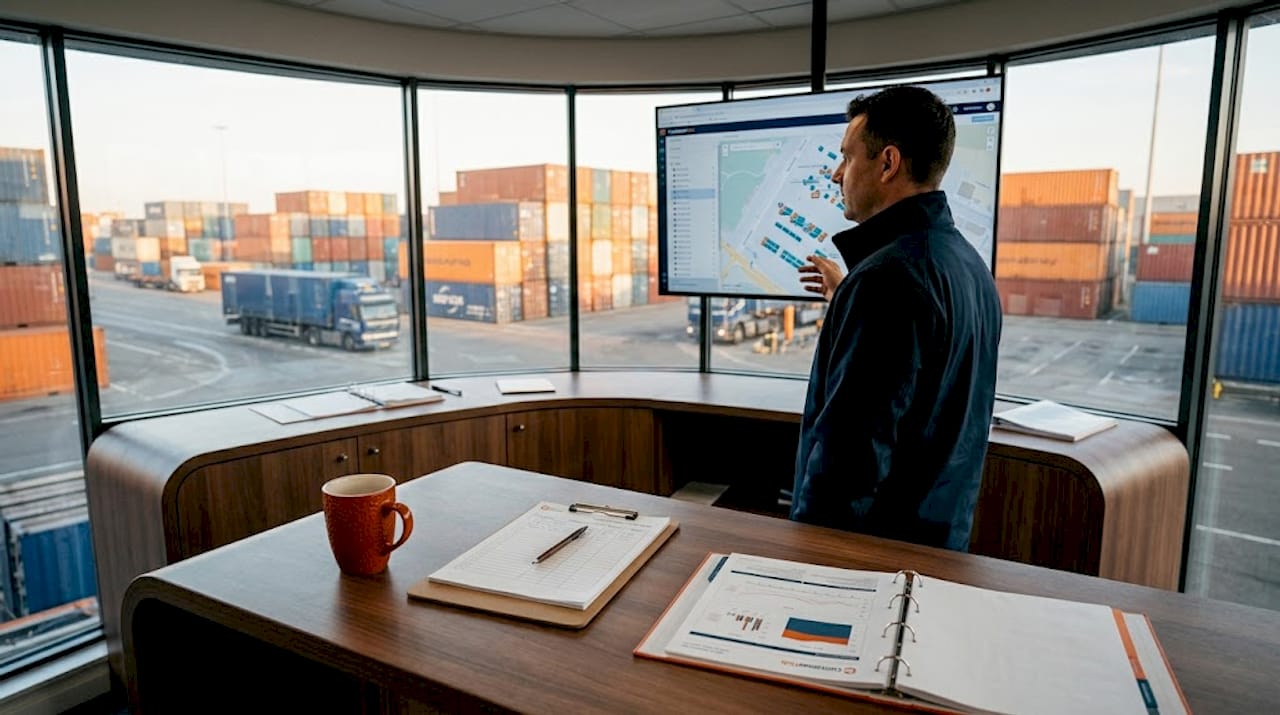
Digital twin technology is emerging as the next layer. A digital twin creates a live virtual replica of your depot yard, showing container positions, dwell times, and status in real time. For multi-depot operations, this means your operations center can see every yard simultaneously without relying on manual updates from site staff.
Fleet management software ties these data streams together. The best platforms today combine GPS, predictive maintenance, fuel efficiency, and compliance tools with open architectures that allow integration with your existing TMS or ERP systems. The fleet management software market is projected to surpass $30 billion in 2026, which reflects how central these platforms have become to logistics operations.
Pro Tip: Don’t wait for a single platform to solve everything. Connect your container tracking data via APIs into a centralized TMS or BI tool. Integrating tracking via APIs into a central system is consistently more effective than expecting one vendor to cover every function across your depot network.
The data quality question is where most implementations stumble. Raw sensor data is only useful if it’s validated before it reaches your dashboard. Fragmented carrier data often causes visibility quality issues, and relying on a single carrier portal leads to manual data stitching that defeats the purpose of automation. Cross-validating feeds from multiple sources, including AIS, EDI, and direct depot systems, is what separates reliable visibility from a dashboard that looks good but misleads you.
Operational benefits of improved fleet visibility
The business case for investing in container fleet visibility across depots is not theoretical. The numbers are concrete, and they show up fast once you close the major gaps.
Unplanned vehicle downtime costs logistics up to $2,000 per day, and that figure doesn’t include the downstream effects of missed pickups and rescheduled deliveries. Integrated maintenance tracking tied to real-time visibility prevents the “we didn’t know it needed service” scenario that accounts for a large share of that cost. When your depot management system flags a container for inspection automatically based on dwell time or damage history, you’re working proactively instead of reactively.
Fuel is the second major lever. Real-time fleet tracking reduces fuel consumption by 12 to 20% in the first year for most operations. That’s not from driving fewer miles. It comes from eliminating unnecessary repositioning trips caused by not knowing where containers actually are, which is a problem that shows up constantly in multi-depot networks.
Here are the key operational benefits logistics professionals consistently achieve after improving visibility:
- Reduced unplanned downtime through predictive maintenance alerts tied to container condition data
- Lower detention and demurrage charges because you can confirm container availability and status before the clock starts
- Improved yard throughput from accurate container positioning data that eliminates search time
- Better inter-depot coordination when all locations share a single data view rather than emailing spreadsheets
- Faster exception resolution because automated alerts surface problems before they cascade into delays
- Higher inventory accuracy across the fleet, which real-time visibility platforms have demonstrated even in warehouse environments exceeding 90,000 square meters
The shift from reactive to proactive management is the real operational transformation. Container intelligence that anticipates delays and enables proactive rerouting turns your operations team from firefighters into planners. That shift has compounding value because every problem caught early prevents three problems downstream.
Challenges in achieving effective visibility across depots
Getting container fleet visibility right across multiple depots is harder than any vendor demo suggests. The technology works. The integration is where most projects stall.
Data fragmentation is the primary obstacle. Each depot may use a different gate system, a different inspection tool, or no digital tool at all. When you aggregate that data into a central dashboard, you’re not just connecting systems. You’re reconciling different data formats, different timestamp conventions, and different definitions of what “available” means for a container unit. Cross-validating data from multiple carriers, terminals, AIS, and EDI sources is what makes the resulting visibility reliable rather than misleading.
The second challenge is the misconception that visibility alone solves delays. Supply chain bottlenecks have shifted to distributed hubs where visibility data exists but exception management workflows don’t. Knowing a container is stuck doesn’t help unless someone is automatically notified and has a clear protocol to act. Real-time data without automated workflows does not prevent operational failures. It just gives you better documentation of them after the fact.
Common pitfalls to avoid include:
- Deploying a single tracking technology and assuming it covers all scenarios
- Skipping data validation layers and displaying raw carrier feeds directly on dashboards
- Treating visibility as an IT project rather than an operations transformation
- Failing to define exception thresholds and escalation protocols before go-live
- Underestimating the change management required at depot level for new data entry disciplines
Pro Tip: Run a pilot at your highest-volume depot first. Track three specific KPIs: dwell time accuracy, gate processing speed, and exception response time. Use those metrics to refine your configuration before rolling out to additional locations. Iterative optimization based on real data beats a big-bang deployment every time.
Implementing a visibility strategy for multi-depot operations
A visibility strategy that works across geographically dispersed depots requires more than buying software. It requires a structured approach that starts with an honest assessment of where your data actually breaks down today.
Follow these steps to build a visibility program that scales:
-
Audit your current visibility gaps. Map every point where container status data is captured manually, delayed, or not captured at all. Gate-in and gate-out records, inspection results, and repair status are the three most common failure points.
-
Define your KPIs before selecting technology. Dwell time by depot, container availability accuracy, exception response time, and inter-depot transfer lead time are the metrics that matter most. Technology selection should follow KPI definition, not precede it.
-
Evaluate vendors on open architecture first. A platform that can’t connect to your existing TMS via API will create a new silo rather than closing old ones. Prioritize vendors with proven EDI integration and open data export capabilities. Container depot software with EDI integration is a baseline requirement for multi-depot coordination.
-
Pilot at one depot with a defined success threshold. Set a 90-day evaluation window. If your target KPIs improve by a defined percentage, proceed to the next location. If they don’t, diagnose before scaling.
-
Integrate gate and yard management into the same data layer. Gate management software that feeds directly into your central visibility platform eliminates the manual transcription step that most depots still rely on. Automated gate processes with license plate recognition and RFID confirmation reduce processing time and eliminate entry errors simultaneously.
-
Build continuous improvement into the program. Visibility data generates insights that improve over time. Schedule quarterly reviews of exception patterns, dwell time trends, and inter-depot transfer performance to identify the next optimization target.
My take on where visibility is actually heading
I’ve worked with enough logistics operations to say this plainly: most teams that invest in visibility technology are still solving the wrong problem. They focus on the dashboard and forget the workflow.
What I’ve seen consistently is that the depots with the best operational outcomes aren’t the ones with the most sensors or the most sophisticated platforms. They’re the ones that defined what they would do when the data showed something wrong. The alert fires. Who sees it? What’s the decision tree? How fast does the resolution happen? Those questions matter more than the refresh rate on your tracking feed.
The other thing I’ve learned is that inter-depot coordination is almost always the last thing to get fixed, even though it’s often where the most value sits. Two depots in the same network operating on different systems with no shared data view will generate more delay and cost than any single depot running on paper. The integration problem between locations is harder than the technology problem at any single location. That’s the uncomfortable reality most implementation plans underestimate.
My honest recommendation: don’t buy a visibility platform. Buy a visibility program. The technology is the easy part. The discipline to act on what it tells you, every time, across every depot, is what separates the operations that improve from the ones that have expensive dashboards and the same problems they started with.
— Deevly
How Containerhub improves visibility across your depot network
If the challenges described in this article sound familiar, Containerhub was built specifically to address them. The platform gives depot operators and shipping lines a single digital layer covering gate management, yard operations, damage inspections, repair workflows, and customer visibility, all connected in real time.
Containerhub’s depot management system replaces paper-based gate processes with automated digital records, feeds live container status into a centralized dashboard, and supports EDI integration with shipping line systems. Whether you’re managing one depot or ten, the platform scales to your network without creating new data silos. Explore ContainerHub’s depot software to see how it maps to your specific visibility gaps and operational requirements.
FAQ
What is container fleet visibility across depots?
Container fleet visibility across depots refers to the ability to monitor the real-time location, status, and condition of all containers across multiple depot sites from a single data view. It covers gate activity, yard positioning, inspection status, and availability.
Why does visibility fail in multi-depot operations?
Visibility fails primarily because each depot uses different systems or manual processes that don’t share data automatically. Fragmented carrier data and the absence of cross-validation between sources create gaps that no single portal can resolve.
How much can better visibility reduce operational costs?
Unplanned downtime alone costs up to $2,000 per day, and real-time tracking reduces fuel consumption by 12 to 20% in the first year. Combined, these savings typically justify visibility technology investment within the first two quarters.
What technologies are most effective for depot-level container tracking?
A layered approach combining GPS for transit tracking, RFID for gate-level confirmation, and IoT sensors for condition monitoring delivers more reliable data than any single technology. Connecting these feeds via API into a central platform is the recommended architecture.
How do I start improving visibility without replacing all existing systems?
Start with a visibility audit to identify your three biggest data gaps. Then pilot a platform with open API architecture at your highest-volume depot, focusing on gate automation and yard management integration before expanding to additional locations.