




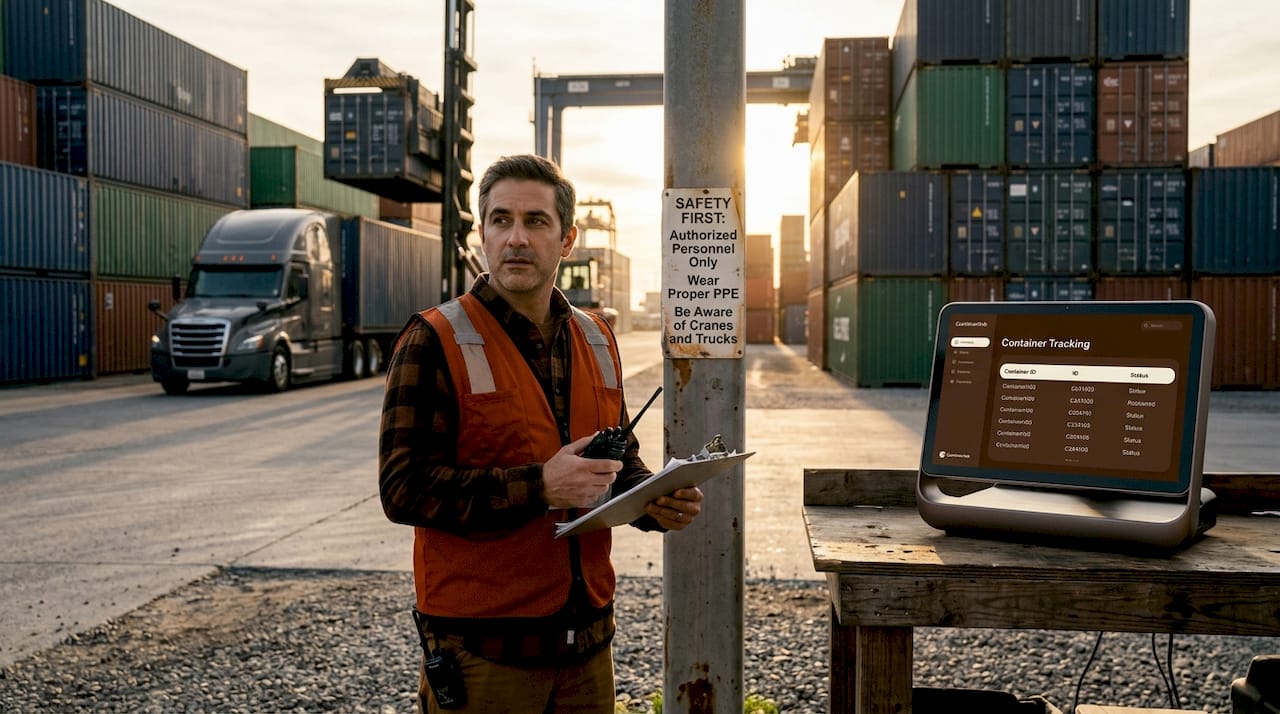
Depot yard management optimization guide
Congestion at the gate, containers sitting in the wrong row, cranes waiting on trucks that haven’t arrived yet. These aren’t fringe problems — they’re daily realities at container depots that lack real-time visibility and coordination. Depot yard management optimization is what separates depots that absorb volume spikes without breaking down from those that fall behind by noon. This guide walks through the tools, scheduling frameworks, stacking strategies, and KPIs that depot operators and logistics managers need to build a yard that actually runs on time.
Table of Contents
- Understanding essential tools and metrics for yard optimization
- Optimizing yard slot allocation and crane scheduling for efficiency
- Coordinating truck arrivals and yard crane tasks to minimize delays
- Selecting container stacking strategies to balance efficiency and energy use
- Leveraging container consolidation during idle crane periods
- Measuring yard performance and verifying optimization results
- Rethinking depot yard optimization: beyond isolated pockets of efficiency
- Optimize your depot yard operations with ContainerHub software
- Frequently asked questions
Key Takeaways
| Point | Details |
|---|---|
| Digital visibility is vital | Real-time tracking and workflow coordination between gates and docks dramatically improve yard efficiency and reduce delays. |
| Joint optimization drives performance | Coordinating yard slot allocation with crane scheduling lowers handling time and truck waiting significantly. |
| Coordinated scheduling reduces costs | Synchronizing truck arrivals and crane tasks minimizes container relocations and operational expenses. |
| Stacking strategy matters | Choosing container stacking methods tailored to flow patterns balances operational speed and energy use. |
| Measure with the right KPIs | Tracking dwell time, truck turnaround, and dock utilization pinpoints bottlenecks and guides continuous yard improvements. |
Understanding essential tools and metrics for yard optimization
Before you can fix a yard, you need to see it clearly. That starts with a yard management system (YMS), the digital backbone of any depot efficiency strategy. A YMS tracks container and trailer status and location, coordinates gate check-ins, assigns dock positions, and manages trailer moves digitally, replacing clipboards and radio calls with a single source of truth.
Layered on top of a YMS, technologies like RFID tags, IoT sensors, and real-time analytics give you the granular data needed to act on what you see. RFID readers at gate lanes capture container IDs automatically. IoT sensors on yard cranes report position and load status. Together, they feed dashboards that show exactly where every asset is and how long it has been there.
The metrics that matter most for depot yard management optimization are well established. Top yard KPIs include trailer dwell time, truck turnaround time, gate throughput time, dock utilization, and yard move cycle time. Tracking these consistently tells you where the yard is bleeding time and where it is not.
| KPI | What it measures | Why it matters |
|---|---|---|
| Trailer dwell time | Hours a container sits before moving | Reveals congestion and planning gaps |
| Truck turnaround time | Gate-in to gate-out duration | Reflects overall yard flow speed |
| Gate throughput time | Time to process one truck at the gate | Identifies gate-lane bottlenecks |
| Dock utilization | Percentage of dock capacity in active use | Flags under or overloaded docks |
| Yard move cycle time | Time per crane or vehicle move | Measures equipment efficiency |
Key technologies to evaluate when building your yard management stack:
- RFID gate readers for automatic container identification on arrival and departure
- IoT crane sensors for real-time position and task tracking
- Cloud-based container yard management software for centralized visibility and reporting
- Gate management software for depots to automate check-in workflows and reduce gate dwell
Pro Tip: Start KPI tracking before you change any processes. Baseline data from even two weeks of measurement will show you which bottleneck to fix first, instead of guessing.
With key tools and performance indicators defined, let’s explore effective strategies for optimizing yard slot allocation and equipment scheduling.
Optimizing yard slot allocation and crane scheduling for efficiency
Most depots schedule yard slots and crane tasks in separate planning cycles. That’s where the inefficiency hides. Joint optimization of slot allocation and dual crane scheduling significantly reduces makespan (total job completion time) and truck waiting times while improving how evenly containers are distributed across the yard.
The core insight is that a container placed in the wrong slot creates extra crane travel later. When slot assignment and crane scheduling are solved together, each placement decision accounts for the retrieval sequence, the crane’s current position, and the spatial separation required to prevent crane collisions.
A practical framework for implementing joint optimization:
- Map container departure windows. Group containers by expected retrieval time. This is your input data for slot assignment.
- Define crane operating zones. Divide the yard into primary and secondary crane zones with a clear buffer to prevent conflicts.
- Run a joint scheduling model. Use available container yard software that incorporates constraint-based scheduling, or work with a logistics engineer to build a simplified model.
- Assign slots based on retrieval priority. Containers leaving soonest go in positions that minimize crane travel to the gate lane.
- Lock the plan and monitor deviations. Real-time tracking lets you re-optimize when truck arrivals shift.
| Approach | Makespan | Truck wait time | Container distribution |
|---|---|---|---|
| Isolated slot + crane planning | Higher | Longer | Uneven |
| Joint optimization model | Lower | Shorter | More uniform |
Pro Tip: Even a simplified joint model, one that just groups containers by departure day and assigns them to crane-zone-aligned rows, outperforms purely reactive slot assignment.
After assigning yard slots and scheduling cranes optimally, controlling the flow of trucks and minimizing disruptions is the next vital step.
Coordinating truck arrivals and yard crane tasks to minimize delays
Uncertain truck arrival sequences are one of the hardest variables to manage in supply chain yard management. When a truck arrives out of sequence, the target container may be buried under others, forcing unplanned relocations that cascade into crane backlogs and longer wait times for every truck behind it.
Coordinating truck arrivals with crane scheduling under uncertainty reduces relocation cost, truck waiting cost, and crane movement cost, while increasing yard resilience when disruptions occur.
Practical steps to implement collaborative scheduling:
- Segment trucks into arrival groups. Cluster expected arrivals into 30 or 60-minute windows and pre-assign retrieval sequences within each group.
- Pre-position containers before the window opens. Use crane idle time to move high-priority containers to accessible positions before their truck group arrives.
- Build buffer slots into the yard plan. Reserve a small percentage of slots near gate lanes for urgent or early arrivals to avoid reshuffling the main stack.
- Communicate sequence changes in real time. When a truck confirms its arrival via a booking portal or SMS, update the crane task queue automatically.
- Collect truck arrival appointment data from your transport management or booking system.
- Match each appointment to its container’s current yard position.
- Identify containers that will require relocation based on their stack depth.
- Schedule pre-retrieval crane moves during the preceding idle window.
- Confirm updated crane task lists with yard supervisors before each arrival wave.
Pro Tip: Even low-tech coordination, like a shared arrival board visible to crane operators, reduces unplanned relocations by making sequence information visible before trucks arrive.
With external truck coordination addressed, let’s consider how stacking strategies affect operational and energy efficiency in the yard.
Selecting container stacking strategies to balance efficiency and energy use
Stacking strategy is a decision most depots make once and never revisit. That’s a mistake. Stacking approaches like FIFO, balanced distribution, and departure-time clustering have distinct effects on reshuffling intensity, handling efficiency, and energy consumption, and the right choice depends on your yard’s specific container flow structure.
| Strategy | Reshuffling rate | Handling efficiency | Energy use | Best for |
|---|---|---|---|---|
| FIFO (first in, first out) | Low to medium | High when flow is predictable | Moderate | Steady, predictable container flow |
| Balanced distribution | Medium | Medium | Lower | Mixed flow with varied departure times |
| Departure-time clustering | Low | Highest | Higher upfront | High-volume yards with defined departure windows |
Key considerations when choosing a stacking strategy:
- Container dwell time distribution. If most containers leave within 48 hours, departure-time clustering pays off. If dwell times vary widely, balanced distribution reduces worst-case reshuffling.
- Crane energy costs. Departure-time clustering requires more upfront moves to organize containers by departure window, which increases energy use during setup but reduces it during retrieval.
- Yard density. At high utilization rates above 80%, any strategy that increases reshuffling becomes expensive fast. Prioritize low-reshuffle approaches when the yard is near capacity.
- Use container yard software with simulation capability to model the impact of each strategy against your actual flow data before committing.
Beyond stacking strategy, effective use of idle crane time for container consolidation further enhances space availability and throughput.
Leveraging container consolidation during idle crane periods
Crane idle time is a hidden resource. When cranes are not handling arrivals or departures, they can consolidate scattered containers into denser, more organized blocks, freeing up slots, reducing future reshuffling, and shortening truck wait times.
Optimizing consolidation during crane idle periods via mixed-integer programming and advanced heuristics improves yard space turnover and reduces operational costs. The math is complex, but the operational logic is straightforward: move containers now so you don’t have to move them twice later.
A step-by-step approach to idle-time consolidation:
- Identify fragmented blocks. Use your YMS to flag yard zones where containers are scattered across multiple rows with gaps between them.
- Prioritize consolidation targets. Focus on containers with the longest remaining dwell time first. Moving them now creates space without disrupting imminent retrievals.
- Generate a consolidation sequence. Plan moves so each crane pass fills a slot and avoids creating new conflicts with the active stack.
- Execute during scheduled idle windows. Align consolidation runs with low-arrival periods, typically late night or early morning, to avoid competing with live operations.
- Verify space gains in the YMS. Confirm that slot availability has improved and update the yard plan before the next arrival wave.
| Consolidation approach | Space freed | Reshuffle reduction | Implementation complexity |
|---|---|---|---|
| Manual ad hoc moves | Low | Minimal | Low |
| Rule-based idle-time moves | Medium | Moderate | Medium |
| Optimization model (MIP + heuristics) | High | Significant | High |
Pro Tip: You don’t need a full optimization model to start. Even a rule-based policy, consolidate any block with more than two empty gaps during the overnight window, delivers measurable space gains within weeks.
Having detailed practical execution, now verify and measure performance using yard KPIs to ensure continuous improvement.
Measuring yard performance and verifying optimization results
Optimization without measurement is just change. To confirm that your depot yard management improvements are working, you need a KPI dashboard that updates in near real time and segments results by cause.
Trailer dwell time calculation segmented by reason codes enables precise bottleneck identification. A container sitting for six hours because of a documentation hold is a different problem than one sitting because no crane was available. Treating them the same masks the real issue.
Key practices for effective yard performance monitoring:
- Tag every dwell event with a reason code (documentation hold, equipment unavailable, scheduling conflict, customer delay) so your data tells a story, not just a number.
- Set threshold alerts in your YMS. When dwell time exceeds your target, the system flags it automatically rather than waiting for a supervisor to notice.
- Review KPIs weekly at the team level. Trends across a week reveal systemic issues. Daily variance is often just noise.
- Benchmark against your own baseline, not industry averages. Your yard’s flow structure is unique, and relative improvement is more actionable than absolute comparison.
Pro Tip: Build a simple weekly KPI scorecard shared with gate staff, crane operators, and planners. When the people executing the work can see the metrics, they surface root causes faster than any analyst can.
Rethinking depot yard optimization: beyond isolated pockets of efficiency
Here is the uncomfortable reality most depot optimization projects ignore: fixing one part of the yard in isolation often just moves the bottleneck. You speed up gate processing, and now the crane queue backs up. You optimize crane scheduling, and trucks start bunching at the exit because documentation isn’t ready. The yard is a system, and systems punish local optimization.
Quay automation gains can be negated if yard throughput can’t absorb incoming container flows. The same principle applies inside a depot: improvements at any single node only hold if the adjacent nodes can keep pace.
The depots that achieve lasting gains treat the yard as a flow network, not a collection of independent tasks. That means modeling gate-to-dock capacity together, not separately. It means aligning your container yard management software with your terminal operating system so data flows without manual re-entry. And it means building governance around your optimization tools, assigning clear ownership for KPI review, model updates, and exception handling.
The most common failure mode we see is a depot that invests in a sophisticated scheduling model, then lets it run on stale data because no one owns the update process. The model degrades, trust erodes, and the team reverts to manual planning. Technology is only as good as the process wrapped around it.
Optimize your depot yard operations with ContainerHub software
Now that you have a clear picture of what depot yard management optimization requires, the next step is finding tools that actually deliver on it without requiring a six-month implementation.
ContainerHub’s container depot management software brings gate management, yard tracking, damage inspections, repair workflows, and billing into a single cloud-based platform. Real-time visibility across every container movement reduces manual errors and gives your team the data needed to act before congestion builds. The platform’s container yard management software integrates with shipping line systems via EDI and includes an AI copilot that surfaces operational insights without requiring a data analyst. Whether you are running a single depot or managing multiple sites, container depot software from ContainerHub scales to your operation. Request a demo to see how it fits your specific yard setup.
Frequently asked questions
What is the primary function of a yard management system (YMS)?
A YMS manages trailer and container movements within a yard, providing real-time visibility and workflow coordination between gates and docks. A YMS tracks trailer status, coordinates gate check-ins and dock assignments, and improves accuracy and operational control.
How does joint optimization of yard slot allocation and crane scheduling improve depot efficiency?
It minimizes container handling time and truck waiting by coordinating container placement with crane tasks, reducing conflicts and improving throughput. Joint optimization reduces makespan and truck waiting times while ensuring uniform container distribution across the yard.
Why is coordinating truck arrivals with yard crane tasks important?
Uncertain truck arrival sequences and storage mismatches cause extra container relocations and waiting, and synchronized scheduling reduces these costs. Coordinating truck arrivals and cranes under uncertainty reduces relocation cost, truck waiting cost, and crane movement cost.
What are common KPIs to measure yard management performance?
Key KPIs include trailer dwell time, truck turnaround time, gate throughput time, dock utilization, and yard move cycle time, which help identify bottlenecks and track improvements. Top impact yard KPIs provide the measurement foundation for continuous depot improvement.
How do container stacking strategies affect yard operations?
Different stacking methods impact reshuffling intensity, operational efficiency, and energy consumption, and the right choice depends on your container flow structure. Stacking strategies significantly affect terminal performance and energy consumption, with effectiveness varying by flow pattern.