


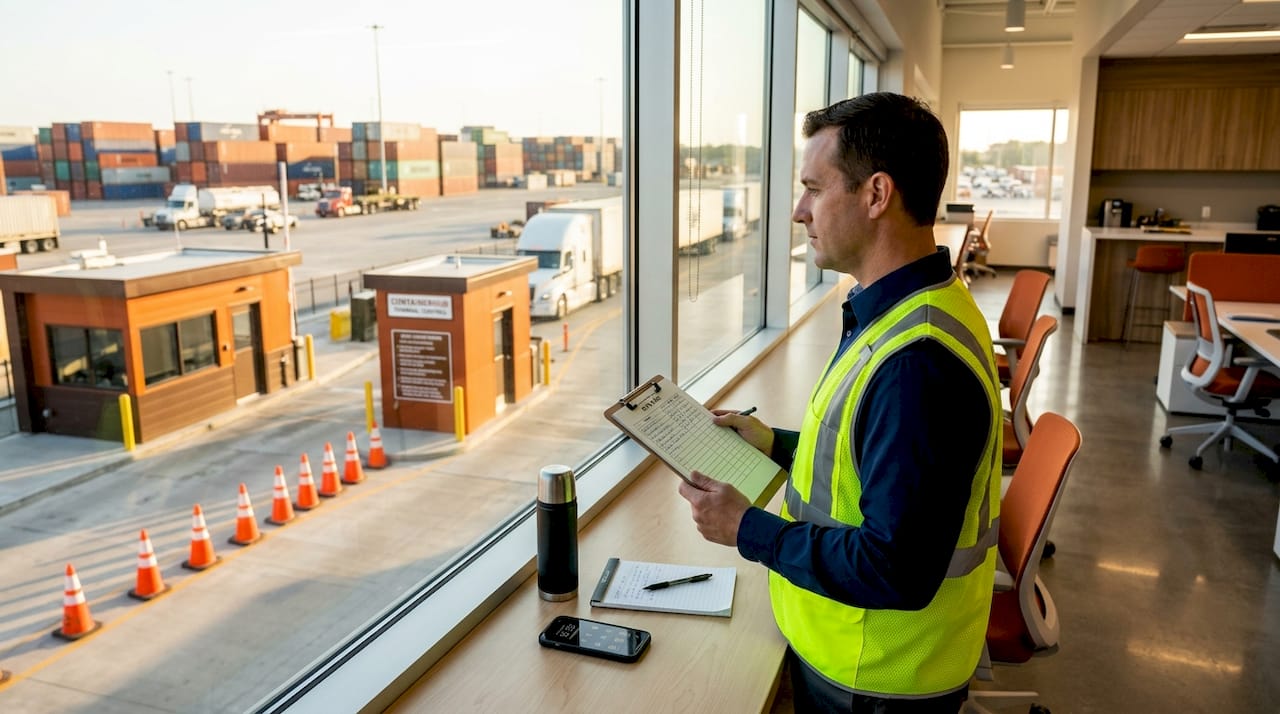
Depot Gate Queue Management Explained for Logistics Pros
Most operations managers think about depot gate management as a security function. Check the driver in, log the container number, wave them through. That mental model is costing depots real money. What is depot gate queue management, really? It’s the systematic control of how trucks, containers, and data move through a depot’s entry and exit points, using technology to eliminate bottlenecks, validate transactions in real time, and generate operational data that feeds every downstream process. Done well, it cuts costs, slashes wait times, and gives you live visibility into your container flow that manual methods simply cannot match.
Table of Contents
- Key Takeaways
- What depot gate queue management actually means
- How automation cuts truck wait times and improves container handling
- Manual vs. automated gate management: a direct comparison
- Practical strategies for implementing depot gate queue management
- Future trends in depot gate queue management technology
- My honest take on depot gate queue management priorities
- How Containerhub supports your gate management operations
- FAQ
Key Takeaways
| Point | Details |
|---|---|
| Gate management is a data function | Every gate event generates data that updates yard, maintenance, and billing workflows in real time. |
| Automation transforms processing speed | Automated systems can complete routine gate entries in under 2 minutes, far faster than manual processing. |
| Exception handling defines real throughput | Automated systems handle roughly 85 to 90% of arrivals; skilled human oversight for exceptions determines overall capacity. |
| Infrastructure matters as much as software | Physical layout, lighting, and connectivity are just as critical as the software stack for reliable gate operations. |
| Scheduling reduces peak congestion | Appointment management and driver self-service tools smooth truck arrival patterns and cut unnecessary queuing. |
What depot gate queue management actually means
At its core, depot gate queue management is the discipline of controlling, sequencing, and processing vehicle arrivals and departures at a container depot’s physical access points. It combines physical infrastructure, software systems, and operational procedures to prevent the kind of unmanaged truck pileups that back traffic onto public roads and stall yard operations for hours.
A modern queue management system at a depot typically includes several core components working together:
- RFID readers and ANPR cameras that identify vehicles and containers automatically before the driver reaches a booth
- AI vision systems that perform damage assessments and seal verification at the gate, capturing photographic evidence without slowing traffic
- Self-service kiosks that let drivers check in, confirm appointment details, and receive bay assignments without waiting for a gate officer
- Appointment validation engines that cross-reference a truck’s arrival against pre-booked slots, flagging mismatches before they become queue problems
- Integration with yard management systems so that a gate-in event automatically updates container location, triggers inspection workflows, and adjusts yard slot allocations
Modern depot gate management technology processes over 3 million gate events annually across large depot networks, which tells you something about the operational scale these systems are built to handle.
Pro Tip: Map your current gate process from truck arrival to yard entry before selecting any technology. Most depots discover three to five manual steps they assumed were unavoidable but can be fully automated.
How automation cuts truck wait times and improves container handling
Here’s where the operational case for gate automation becomes hard to ignore. The traditional manual gate process requires a driver to stop, present paperwork, wait for a clerk to verify documents, log the container number by hand, complete a damage check, and receive a yard assignment verbally. Every one of those steps adds time. More importantly, every one introduces error.
Automated systems collapse this sequence dramatically. Gate-to-yard costs drop by up to 70% with full gate automation, and routine entries complete in under 2 minutes. Consider what that means at a depot processing 300 trucks per day.
The operational improvements break down across four dimensions:
- Vehicle identification happens before the driver parks. RFID and ANPR read the truck and container data automatically, eliminating transcription errors and cutting the first stage of processing to seconds.
- Real-time validation checks appointment status, container release authorization, and customer account standing simultaneously. Problems surface before the truck enters the yard, not after.
- Condition documentation through AI vision captures timestamped photos of container condition at arrival and departure. This creates an auditable record that protects depots in damage disputes and feeds directly into repair authorization workflows.
- Yard assignment is generated automatically based on container type, destination, and current yard layout, removing the verbal instruction step that frequently causes misroutes.
The safety dimension is also significant. Smart gates deliver 100% identification and authorization of every vehicle entering a controlled site, eliminating manual log errors that create unauthorized access risks. Beyond access control, well-designed gate infrastructure removes stop-start uncertainty. Physical gate design reduces the ambiguity that causes minor collisions and near-misses in busy depots. Drivers know exactly where to stop, what to do, and when to proceed.
Manual vs. automated gate management: a direct comparison
If you’re still running a manual gate operation or evaluating whether automation justifies the investment, this comparison puts the decision in concrete terms.
| Operational metric | Manual gate process | Automated gate system |
|---|---|---|
| Average processing time per truck | 8 to 15 minutes | Under 2 minutes |
| Labor cost per gate lane | $25,000+ per month | Significantly reduced with kiosk-based processing |
| Data accuracy | Dependent on clerk attention | Consistent, automated capture with full audit trail |
| Error rate in container records | High; manual transcription prone to mistakes | Near zero for routine transactions |
| Condition documentation | Inconsistent; paper-based | Timestamped photos linked to container records |
| Integration with yard systems | Manual re-entry required | Automatic real-time updates to yard and maintenance workflows |
| Unauthorized access risk | Significant; relies on human judgment | Minimized through biometric and vehicle verification |
The labor cost figure alone is striking. Gate automation kiosks replace more than $25,000 in monthly labor per gate lane while generating detailed event logs that manual processes never could.
That said, automation does not eliminate the human role entirely. Automated systems handle 85 to 90% of routine gate transactions without intervention. The remaining 10 to 15%, which includes vehicles with damaged documentation, container mismatches, or unexpected cargo conditions, requires a skilled operator to resolve. How well a depot manages those exceptions determines its real throughput ceiling.
Pro Tip: Designate a dedicated exception resolution lane and train your most experienced gate staff to handle only non-routine cases. Mixing exception handling with routine traffic defeats much of the throughput gain from automation.
Practical strategies for implementing depot gate queue management
Understanding what depot gate queue management involves is one thing. Building a system that actually delivers the efficiency gains is another. Here’s what operations managers need to get right during implementation.
Physical infrastructure comes first. Software alone cannot fix a poorly designed gate area. Many depots invest more in site build-out than in the software itself, addressing lane geometry, lighting quality, sensor placement, and connectivity infrastructure. A well-lit, clearly marked approach lane improves both camera read rates and driver behavior before any software touches the process.
Integration must be bidirectional. Gate events should update your container yard software automatically, but the yard system also needs to push data back to the gate. When a container is flagged for hold or a customer account is suspended, the gate system needs to know before the truck arrives, not after it has already entered.
Best practices for a successful deployment include:
- Scheduling and appointment management to distribute arrivals across operating hours and avoid artificial peak loads at shift changes
- Driver communication tools including SMS notifications, kiosk interfaces, and clear lane signage so that drivers know their status without requiring gate staff intervention
- Centralized monitoring dashboards that give supervisors a real-time view of queue length, lane status, and average processing time across all active lanes
- Regular performance reporting that tracks gate throughput, exception rates, and average dwell times so that you can identify degradation before it becomes a problem
- Documented exception workflows with clear escalation paths so that the 10 to 15% of non-routine cases are resolved quickly and consistently
Sustainability is a genuine secondary benefit. Reduced truck idling translates directly into lower emissions at the depot, which matters increasingly for operators managing scope 3 emissions reporting and community relations.
Pro Tip: Pilot your gate automation system on your lowest-volume lane first. Resolve the edge cases and exception workflows before scaling to high-traffic lanes. The failure modes you discover during the pilot will be completely different from what you anticipated on paper.
Future trends in depot gate queue management technology
The next generation of gate management technology is moving from automation to intelligence. Several trends are worth watching closely.
- AI-based anomaly detection is becoming standard in newer systems, flagging unusual patterns such as a container arriving that was not expected in the region, a seal that does not match the manifest, or a driver whose biometric profile does not align with the registered carrier. These checks happen in real time without adding processing time.
- Remote operator models allow a single trained operator to monitor and manage exceptions across multiple depot gates simultaneously, rather than stationing staff at each booth. This pooled staffing approach is already reducing operational labor costs at larger terminal networks.
- Full container lifecycle integration is the direction platforms like Containerhub are pursuing, where gate events connect directly to inspection records, repair authorizations, billing cycles, and customer portals. The gate becomes the first data capture point in a chain that extends across the entire container’s depot life.
- Predictive queue management uses historical arrival patterns and appointment data to pre-position yard resources and staff before demand peaks, rather than reacting after queues have already formed.
The challenge in adopting new technology is avoiding the trap of adding capability before the foundational infrastructure is solid. Many depots deploy sophisticated AI systems on top of unreliable physical infrastructure and then wonder why read rates are inconsistent. Get the basics right first.
My honest take on depot gate queue management priorities
I’ve spent considerable time analyzing how depots approach their gate operations, and the most consistent mistake I see is sequencing the investment backwards. Teams get excited about AI vision and biometric verification, spend heavily on software, and then discover that their gate lane is too narrow for a loaded truck to approach cleanly, or that connectivity drops every time a freight train passes the perimeter. The software cannot compensate for a fundamentally flawed physical setup.
The second thing I’ve learned is that the exception management process is where most depot managers underestimate the work required. When a system is handling 85 to 90% of transactions automatically, the remaining cases can feel like a small problem. They are not. A single complex exception during peak arrival, a container with a cracked corner post and ambiguous responsibility, a driver without a valid appointment whose shipping line has just authorized a release verbally, can block an entire lane for 20 minutes. Multiply that across a busy day and you’ve lost the throughput gains you paid for.
What actually separates high-performing depot gate operations from average ones is not the sophistication of the technology. It’s the quality of the exception workflows and the discipline of the appointment management system. You can achieve 80% of the benefit with a well-designed scheduling system and clear escalation procedures. The depot yard management optimization work that underpins gate efficiency is fundamentally about process discipline, not just software.
My take: buy the technology, but invest the same energy in your operating procedures. The hardware and software will handle the routine. Your team’s judgment will determine how you handle everything else.
— William Carley
How Containerhub supports your gate management operations
Containerhub is built specifically for container depot operators who need more than a generic logistics platform. The gate management software digitizes every step of the gate-in and gate-out process, from appointment validation and container identification through damage capture and billing triggers, with every event feeding directly into the yard management and inspection workflows.
The platform integrates with shipping line systems via EDI, which means your gate data does not live in a silo. Container status updates, release authorizations, and customer notifications happen automatically. The container depot software also includes a client portal so that shipping lines and customers can check container status without calling your operations team.
If your depot is still running paper-based gate logs or managing exceptions through phone calls and spreadsheets, Containerhub is worth a close look.
FAQ
What is depot gate queue management?
Depot gate queue management is the process of controlling, sequencing, and automating the flow of trucks and containers through a depot’s entry and exit points to reduce wait times, improve data accuracy, and feed real-time information into yard and maintenance systems.
How do automated gate systems reduce wait times?
Automated systems use RFID, ANPR, and AI vision to identify vehicles and validate transactions simultaneously, completing routine gate entries in under 2 minutes compared to 8 to 15 minutes for manual processing.
What technology is used in modern depot gate management?
Modern depot gate management systems use RFID readers, automatic number plate recognition cameras, AI vision for damage detection, self-service driver kiosks, and appointment management software integrated with yard management platforms.
Why does exception management matter in gate automation?
Automated systems handle approximately 85 to 90% of routine transactions, but the remaining 10 to 15% of non-routine cases require skilled human resolution. How quickly those exceptions are handled determines the depot’s actual throughput capacity.
What are the main benefits of a queue management system at depot gates?
Key benefits include lower labor costs, faster truck turnaround, reduced transcription errors, automated condition documentation, improved safety through controlled access, and real-time data integration with downstream depot workflows.