

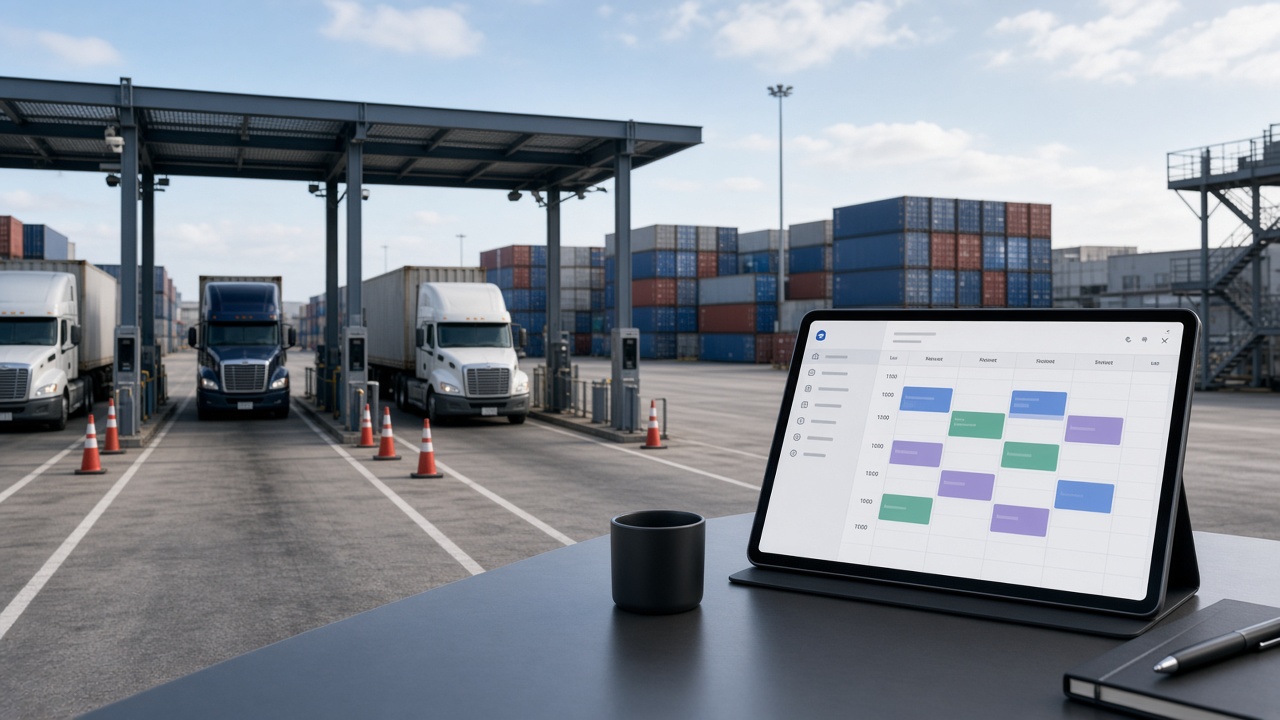
Friday, 07:40. Three trucks are already nose-to-tail outside the empty yard. The first has a booking number the night shift wrote on a sticky note. The second has a container number and no slot. The third says the line “confirmed by email.” Gate In has not started, the EIR tablet is still cold, and the desk is already inventing a queue religion that billing will argue about at month-end.
That is the vehicle booking system for container depot problem in plain US ops language. Not “how do we stamp a digital EIR faster” (the gate product already owns booth capture). Not “what does Available mean.” A who-is-coming-before-the-booth problem: appointments and pre-advice must sit on the same timeline Gate In, dwell, and release will use—so the desk stages empties against real slots instead of radio guesses.
This piece is for operators evaluating a vehicle booking system for container depots on an empty-container depot/yard OS (~200–5,000 TEU)—gate, EIR, inspections, M&R, yard, billing, portal, Jarvis—not a freight TMS and not a marine terminal TOS / port VBS. Gate queues and EIR capture belong with gate management software for depots. Hold and release on one unit belong with empty container hold and release. Here the focus stays on appointments + pre-advice tied to the gate before the truck hits the booth.
Why empty-depot queues are an ops and billing problem, not just a “busy gate”
A long line at an empty depot looks like traffic. Internally it is usually a forecast failure.
What the queue actually burns:
- Yard crew digs the wrong bay because nobody knew the slot’s size/grade until the plate was at the booth
- Gate dwell stretches while the clerk rebuilds booking facts from email, WhatsApp, and a photocopied release
- Storage and handling clocks start late, early, or on the wrong truck—so dispute packs fight over who arrived when
- Lines blame the depot for “no empties” when an unbooked walk-up stole a reserved window
Busy gates happen. Unbooked peak mornings that destroy stage plans and billing evidence are an ops design choice. A vehicle booking system for container depots earns its keep when the slot, the unit ask, and the Gate In event share one clock—not when someone prints a prettier appointment PDF.
Practical rule: if the desk only learns who is coming when the truck blocks the camera, you do not have booking—you have a longer queue with better excuses.
Appointments vs walk-ups: what the desk needs before Gate In
Walk-ups are not illegal. Unplanned walk-ups during a booked peak window are how reserved empties miss their trucks.
Before Gate In, the desk should already see:
- Slot window — who owns the time, and whether the truck is early / on-time / late
- Move type — empty Gate In, empty Gate Out, dual move, or inspection-only
- Unit ask — container number when known, or size/type/grade/programme for an equivalent empty
- Haulier / plate / driver contact — enough to match the truck without a radio scavenger hunt
- Booking status — confirmed, no-show risk, cancelled, or walk-up pending acceptance
Appointments without those fields become decorative calendar tiles. Walk-up policy should be explicit: accept into open capacity, force a same-day slot, or refuse during protected programme windows—written once, enforced at the booth.
Practical rule: the booth validates a booking the desk already prepared; it should not invent the booking under pressure.
Pre-advice that matches the booking (and what to do when it doesn’t)
A booking without matching pre-advice is a polite rumour. Pre-advice without a booking is a surprise truck with paperwork.
Match means the same commercial facts the gate will stamp: container number (or eligible equivalent under grade/programme rules); move direction and expected window; line / client / release or return authority; any hold or special-handling note that should change stage work before the truck arrives.
When booking and pre-advice diverge, the desk needs an exception queue, not a louder email thread: wrong unit, wrong size/type, cancelled slot still showing confirmed, early arrival outside the window, dual-move second leg missing. For how pre-advice / EDI events should land on the depot timeline, see CODECO EDI for empty container depots—this spoke only needs the booking and the advice to agree before Gate In.
Practical rule: if mismatch only surfaces when the clerk keys Gate In, booking and pre-advice never shared a system of record.
Soft check: pick one peak morning last week. If slot list, pre-advice, and Gate In evidence lived in three places—and the queue was “managed” by radioyou do not have a vehicle booking system for container depots yet. You have archaeology with turn signals. See appointment-aware gate ops on containerhub.ai.
How booking status should update gate dwell and Available without a second sheet
Booking status that only lives in a calendar tab drifts the moment the first no-show happens.
Minimum automatic updates on the same timeline the gate and yard already use:
- Confirmed booking → reserves the slot and, where rules say so, soft-reserves the eligible empty / programme slice
- Truck arrived / Gate In started → starts dwell against the booked window; ties EIR and unit events to that booking ID
- No-show / late past grace frees the slot and clears soft reservation for the next eligible ask
- Cancelled / rescheduled → updates Available and stage work without a side “today’s bookings” sheet
- Gate Out complete → closes the booking so the next ask does not see a ghost reservation
Available definition stays with container availability management. Hold/clear authority stays with empty container hold and release. Booking owns whether slot state and reservation change those releasability facts without a second workbook. Product spine: empty container depot software. Gate product context: gate management software for depots.
Reject: a Google Sheet titled APPOINTMENTS; a WhatsApp pin of plate numbers; a port-style VBS login that never writes Gate In/Out to the depot unit timeline; two systems where the calendar says confirmed and the yard sheet still shows the unit free for anyone.
Depot OS vs marine TOS: keep the frame on empty-container facilities
Port and marine terminal VBS tools solve berth, vessel, and terminal-truck congestion at a different scale. Empty-container depots (~200–5,000 TEU) need something narrower:
- Slots tied to empty Gate In / Gate Out, dual moves, and depot inspection—not vessel cut-offs
- Pre-advice and release rules that match line programmes, grade, and holds on depot units
- Billing and storage clocks that start from depot Gate In/Out, not terminal move history
- A desk that answers hauliers and lines from the same unit timeline used for EIR, M&R, and Available
Calling a marine TOS “depot VBS” usually means buying berth complexity the yard will never use—while the sticky-note booking list survives. A depot OS frames vehicle booking as appointment-aware gate and yard ops: who is coming, which empty they need, whether pre-advice matches, and how slot status updates dwell and Available.
Reject as the answer for this buyer: freight TMS empty-TEU maps; standalone calendar SaaS with no gate events; marine terminal camera/VBS stacks pitched at inland empty yards; directory “claim your depot” flows that never touch Gate In.
Buyer checklist: appointment readiness that survives peak morning
Walk this with the gate lead and the line-facing desk before the next booked peak:
| Check | Pass looks like |
|---|---|
| Slot before booth | Desk sees confirmed window, move type, and unit ask before the truck hits the camera |
| Walk-up policy written | Open capacity, same-day slot, or refuse during protected windows—enforced once |
| Pre-advice matches booking | Container / size-type-grade / authority agree before Gate In, or land in an exception queue |
| Booking ID on Gate In | EIR and unit timeline cite the same booking the calendar used |
| No-show frees capacity | Late/cancelled slots clear soft reservations without a side sheet |
| Dwell vs window | Early / on-time / late is visible against the booked slot, not tribal memory |
| Available stays honest | Soft reservation and holds do not invent a second Available religion |
| No peak-morning sticky list | Friday 07:40 does not rebuild the queue from email and radio |
Nice-to-haves: haulier self-serve reschedule inside grace rules; portal-visible slot status scoped by client; alerts when pre-advice and booking diverge before the truck is on site.
ContainerHub’s framing: appointments and pre-advice on the same depot OS spine as gate, EIR, yard state, Available, and billing—so queue control is a consequence of shared events, not a prettier calendar.
Soft CTA: appointment-aware gate ops on containerhub.ai
If the morning queue still starts with sticky notes, unmatched pre-advice, and a booth that invents the booking under pressure, the fix is not another WhatsApp group. It is a vehicle booking system for container depots that ties slots to gate/EIR and keeps Available honest when status changes.
ContainerHub is a depot / yard OS for empty-container operations (~200–5,000 TEU)—gate, digital EIR, inspections, M&R, yard, billing, client portal, and Jarvis on one model—not freight TMS, not WMS, not a marine TOS / port VBS pitch. Soft next step only: review the product, book a demo, or compare pricing. No directory “claim your depot” ask.
Walk one booked peak morning in a demo. Ask whether slot, pre-advice match, Gate In, dwell, and Available stay on the same timeline when the first no-show hits.
Visit ContainerHub Pricing · Demo
Related reading: Gate management software for depots · Empty container depot software · Empty container hold and release · Container availability management · CODECO EDI for empty container depots